Free
€0/ month
- Three daily briefings — Tokyo, London, New York
- Weekend Edition & Weekly Outlook
- Bilingual delivery — English or French
- Pentagon Pizza alerts on critical levels
A market analyst that never sleeps. Every session open, it has already read the fundamentals of over a thousand stocks, tracked where institutional money moved, watched the macro calendar and set aside what doesn’t move anything. What’s left reaches you — in Telegram, or on your dashboard.
Each session opens with the same ritual. Argus pulls live prices, supplementary depth across asset classes, the economic calendar, and the latest must-reads from a curated set of sources. It cross-references everything, deduplicates the headlines, and writes.
The result is a single Telegram message — never longer than what you can read while your coffee cools. Macro context, FX and crypto levels at the actual candle close, two or three must-reads, the events of the next eight hours, and a calm verdict on the regime.
No invented levels. No moralising. UTC throughout.
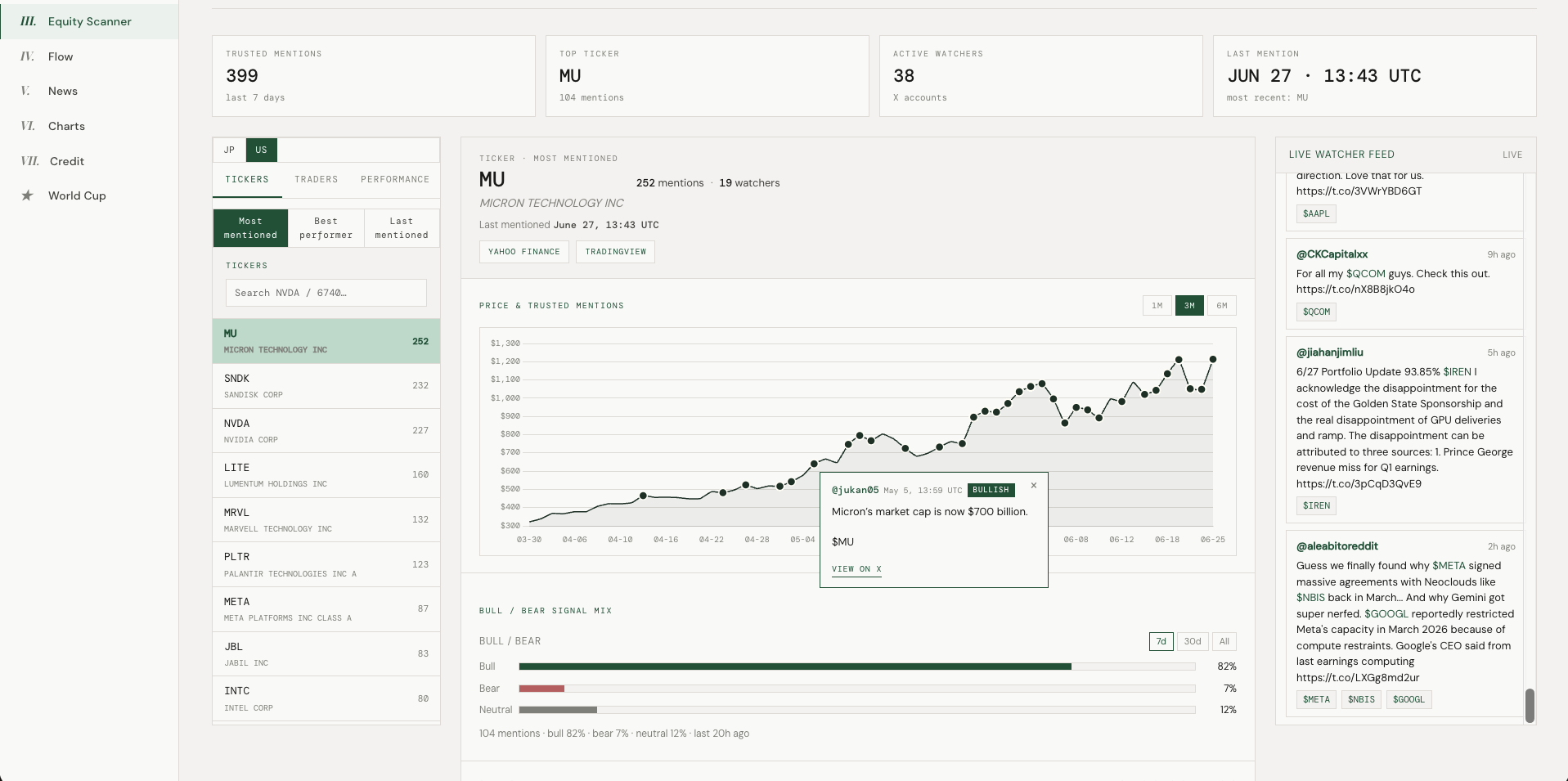
A curated network of analysts on X, watched continuously. Each mention parsed, deduplicated and scored. When a ticker — most often a Japanese small or mid-cap — crosses a threshold of independent corroboration in a tight window, Argus opens an alert.
The scanner runs hourly. The scorer follows thirty minutes later. Quiet by design — most hours produce nothing.
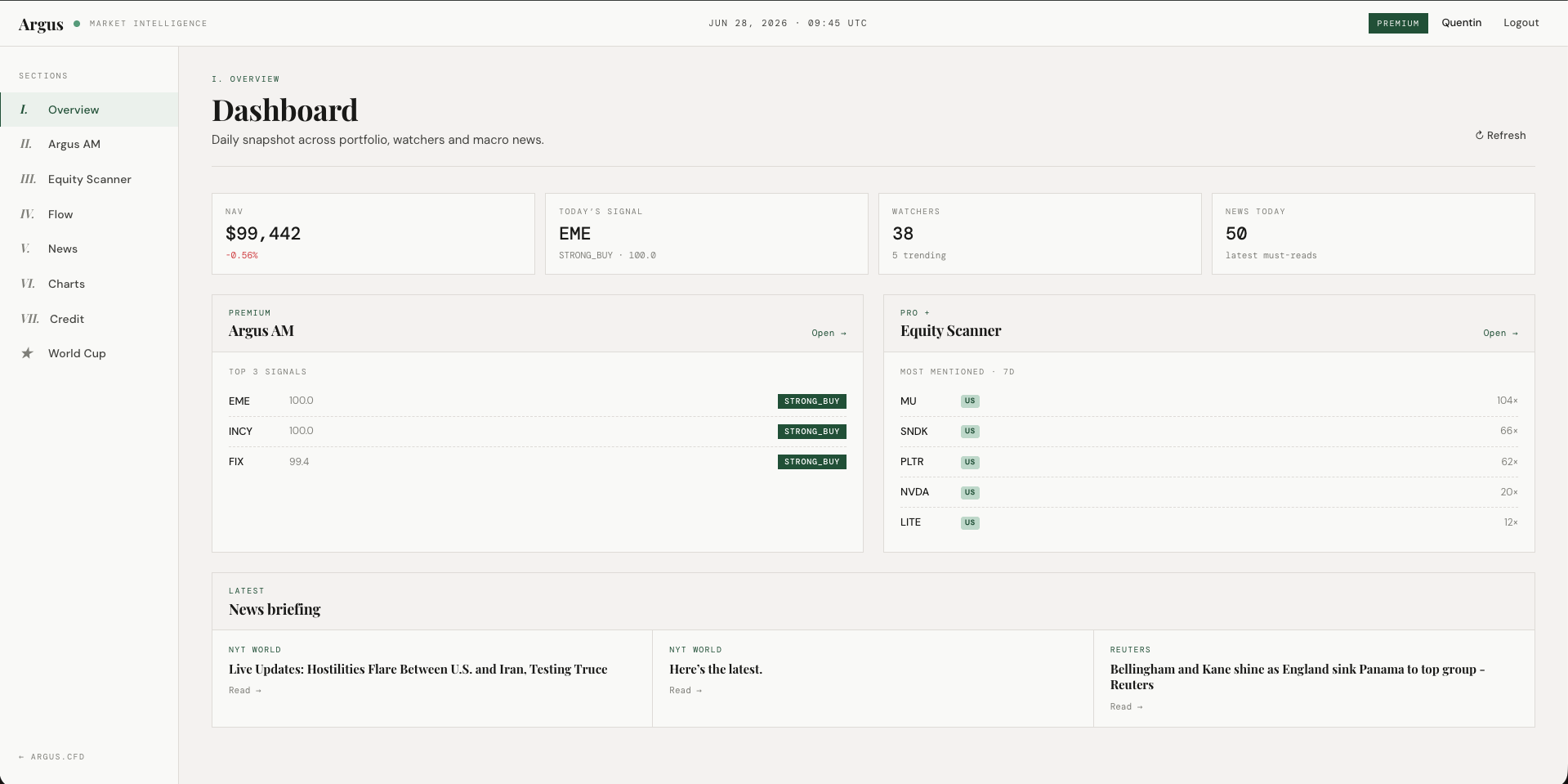
A daily institutional-grade screen of the S&P 500 and Nasdaq 100 — several hundred US large-caps — scored on four pillars: Quality, Valuation, Momentum and Growth. Each pillar is computed sector-aware, peer-relative, and penalised for value traps and death spirals. Position sizing reconciles a fractional Kelly with an ATR-based volatility target and a regime cap; exits trail a high-water mark with cooling periods after every sell.
Running in production since inception on 26 May 2026. The portfolio is paper; the discipline is real.
Institutional money leaves footprints — 13F concentration, sector rotation, value-chain correlations. Argus Flow reads them: where capital is crowding in, which sectors are gaining or losing sponsorship, and how the names you hold sit inside the institutional supply chain.
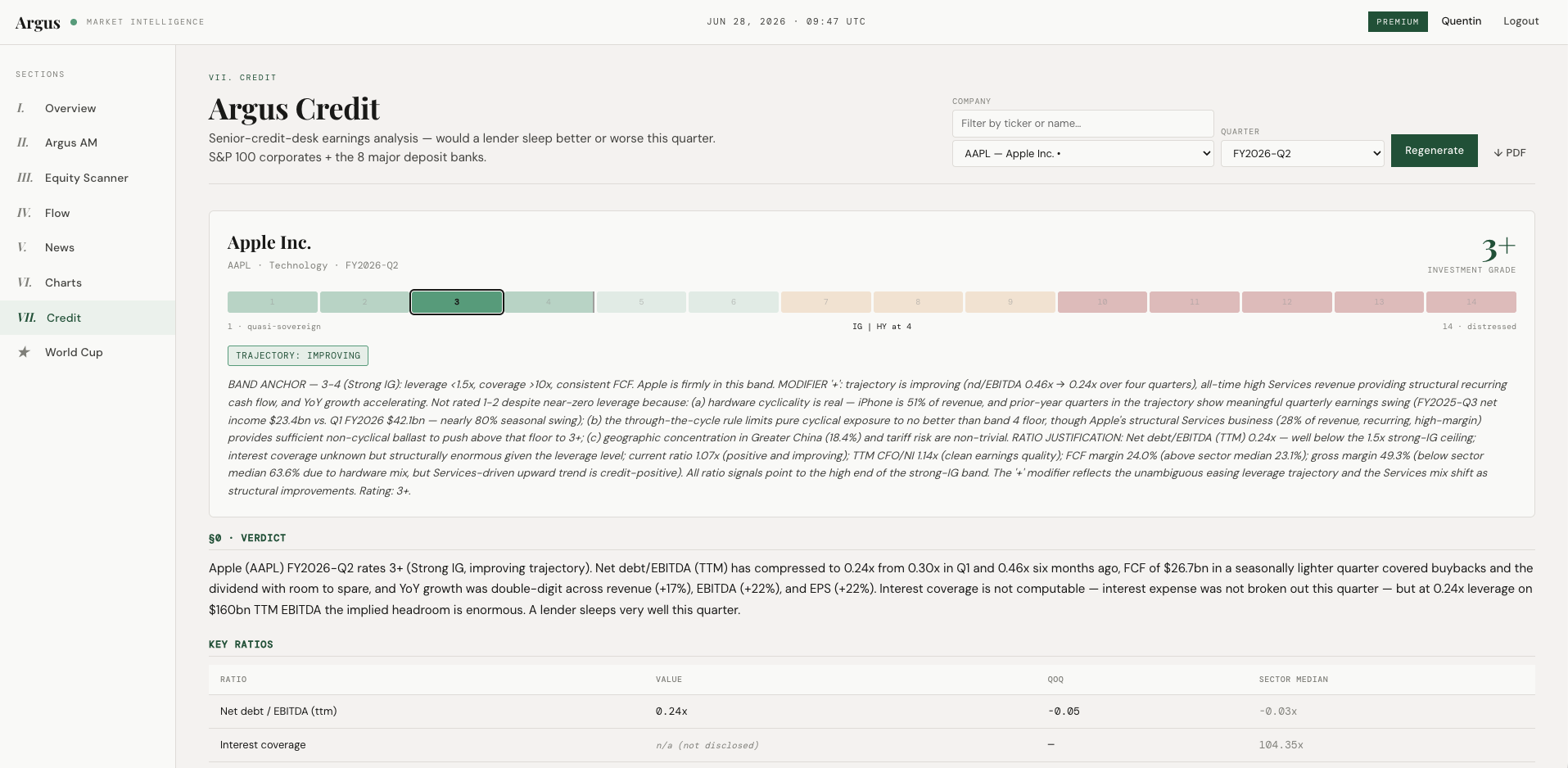
A share price tells you what the market feels. Corporate credit tells you whether the company can pay. Argus Credit screens the bond side — leverage, coverage, refinancing walls, spread moves — so you see the financial health the equity tape hides.
An old Washington observation: when something is unfolding at the Pentagon, the pizzerias on the perimeter run hot late into the night. The pattern has shadowed enough historical episodes — Grenada, the Gulf, the night of September 10, 2001 — that journalists turned it into a quiet leading indicator.
Argus tracks pizza traffic around the building and combines it with Polymarket conflict-probability prints. The composite is called DOUGHCON — five for calm, one for critical. Subscribers are alerted only on elevated levels.
Everything Argus computes is visible in the dashboard — the briefings archive, the equity-scanner live feed, the AM portfolio with its pillar scores, the flows. Not a mockup: the working product.